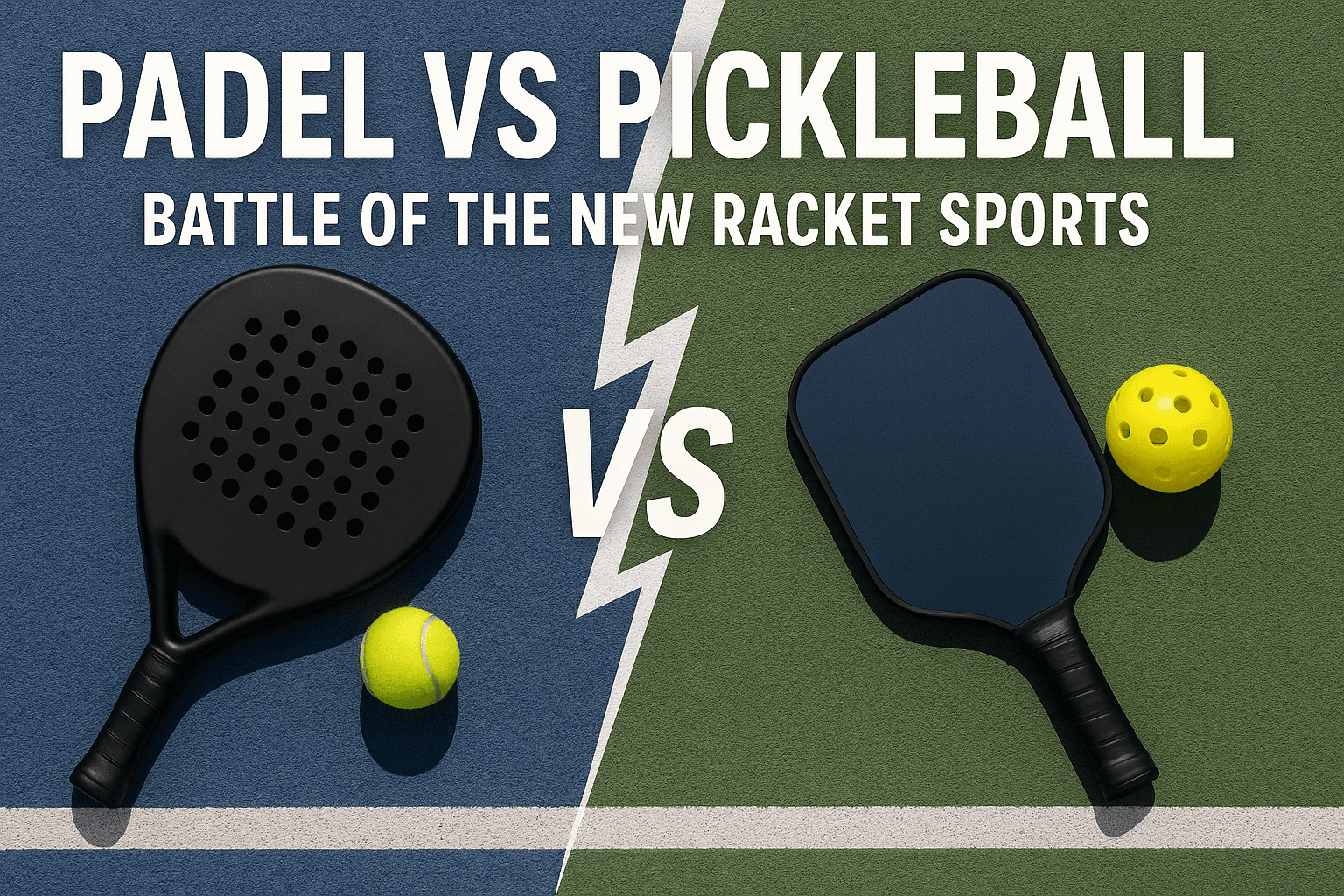
Padel vs. Pickleball: Battle of the New Racket Sports
Two racket sports are currently experiencing explosive growth worldwide: padel and pickleball. While both are relatively new to many markets, they're capturing the hearts and courts of millions. But what exactly sets these sports apart, and which one might be the right fit for you?
Let's dive deep into the similarities, differences, and unique appeal of both padel and pickleball.
The Origins: Different Continents, Similar Spirit
Padel was invented in 1969 by Mexican businessman Enrique Corcuera, who wanted to build a tennis court at his vacation home but was constrained by space. The sport took off in Spain and Argentina, where it became deeply embedded in the culture.
Pickleball emerged in 1965 on Bainbridge Island, Washington, when three families wanted to entertain their children during summer. Named after the Pritchard family's dog Pickles, it spread throughout the United States and has recently exploded in popularity.
Court Design: Enclosed vs. Open
Padel courts are fully enclosed with walls and mesh. The court is 20m x 10m (about 2/3 the size of a tennis court) and the walls are part of the game. Players can use the walls strategically, similar to squash.
Pickleball courts are open-air and smaller than tennis courts (20' x 44'). They feature a distinctive “kitchen” or non-volley zone near the net, which creates unique strategic gameplay.
Equipment: Solid vs. Perforated
Padel rackets are solid with no strings, featuring small holes for aerodynamics. They're typically made of carbon fiber or fiberglass. The balls are similar to tennis balls but with slightly less pressure.
Pickleball paddles are also solid but larger than padel rackets. The balls are plastic with holes, creating a slower, more controlled game. Equipment costs are generally lower for pickleball.
Gameplay: Power vs. Finesse
Padel is played exclusively in doubles and emphasizes power, strategy, and wall play. Points tend to be longer and more dynamic, with serves being underhand. The enclosed court creates spectacular rallies and athletic shots.
Pickleball can be played in singles or doubles, but doubles is more popular. The game emphasizes placement over power, with a unique serving system and the “kitchen” rule creating strategic depth. It's generally considered easier on the body.
Learning Curve: Different Challenges
Padel has a moderate learning curve. While the underhand serve is easier than tennis, mastering wall play and the fast-paced nature requires practice. However, beginners can have fun immediately thanks to the enclosed court keeping balls in play.
Pickleball is often praised for being the easiest racket sport to pick up. The slower ball, smaller court, and underhand serve make it very accessible to beginners of all ages and fitness levels.
Global Reach: Europe vs. North America
Padel dominates in Europe, particularly Spain, Sweden, and Italy. It's also huge in Argentina and growing rapidly in the Middle East. The sport is just beginning to gain traction in the United States.
Pickleball is experiencing massive growth in North America, with the U.S. leading the charge. It's the fastest-growing sport in America for three consecutive years. International expansion is beginning, but it's still primarily a North American phenomenon.
Investment and Infrastructure
Padel courts require significant investment due to the enclosed structure, lighting, and ventilation needs. However, they can be built vertically and multiple courts can share walls, making them space-efficient in urban areas.
Pickleball courts are cheaper to build and can often be converted from existing tennis courts. This has accelerated adoption in communities looking to add sports facilities quickly and affordably.
Professional Scene: Established vs. Emerging
Padel has an established professional circuit with the World Padel Tour featuring top players from Spain and Argentina. The sport is pushing for Olympic inclusion and has significant prize money and sponsorships.
Pickleball is rapidly professionalizing with multiple competing tours and leagues. Prize money is growing quickly, and major brands are investing. The professional scene is newer but developing fast.
Which Sport Is Right for You?
Choose Padel If You:
- Enjoy high-energy, athletic gameplay
- Like strategic depth and wall play
- Want longer, more dynamic rallies
- Are looking for a sport with European flair
- Don't mind a steeper learning curve
Choose Pickleball If You:
- Want an easy sport to learn and play
- Prefer strategy over power
- Have concerns about joint impact
- Want lower equipment and court costs
- Enjoy a strong, growing community (especially in North America)
The Verdict
Both sports offer fantastic ways to stay active, socialize, and have fun. Padel brings European sophistication and athletic intensity, while pickleball offers American accessibility and rapid growth.
The truth is, you don't have to choose just one. Many players enjoy both sports for their unique qualities. Whether you pick up a padel racket or a pickleball paddle, you're joining millions of people discovering the joy of these exciting racket sports.